
The Ultra-Processed Default
Ultra-processed products are everywhere in stores, schools, and time-poor households. Willpower is not the issue.
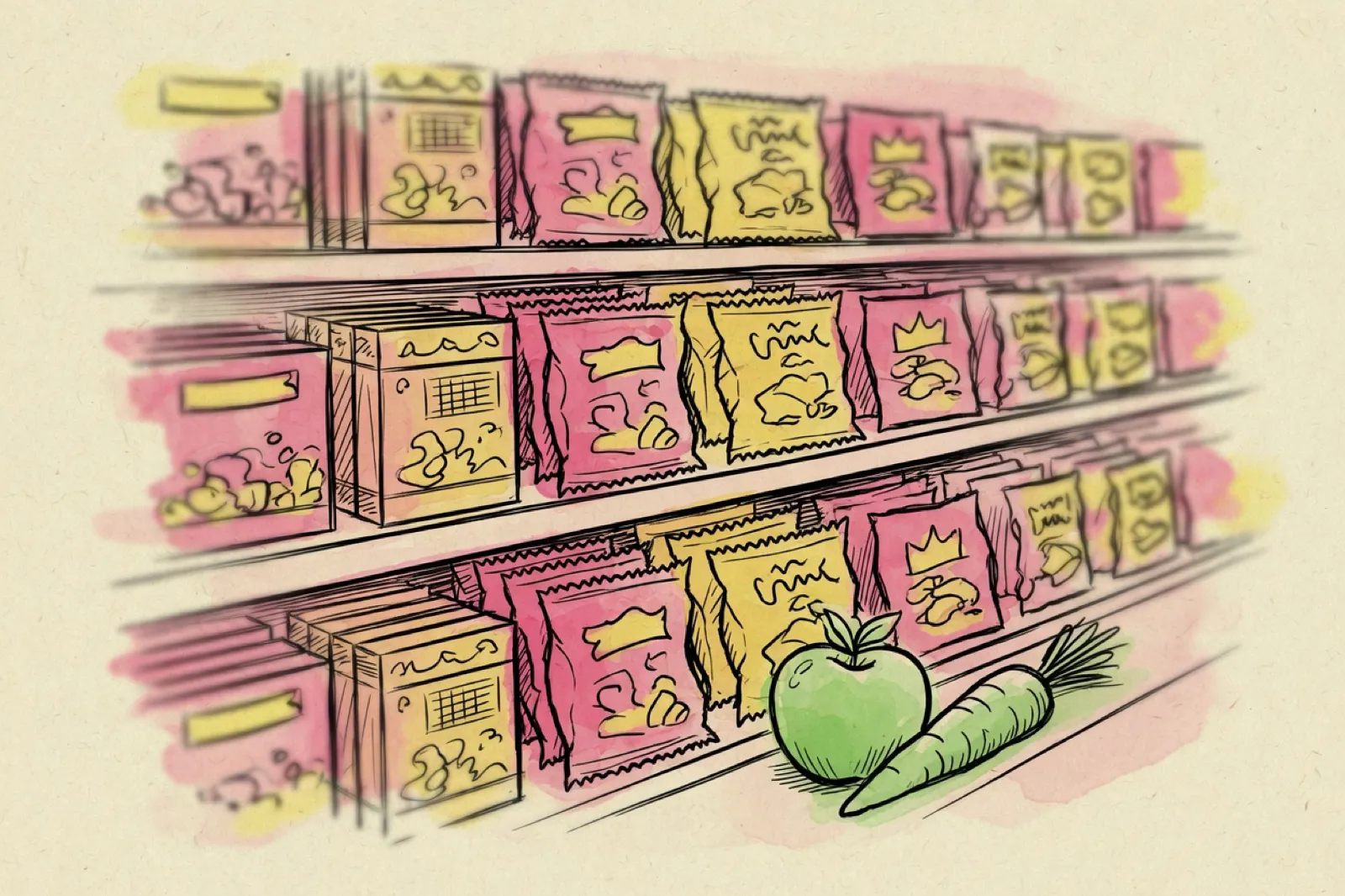
When people talk about obesity and type 2 diabetes, the conversation lands on character. More discipline, better choices, stronger will. In much of America the easy choice is ultra-processed food. Real food takes more time, money, or planning.
I think most people are swimming in a tank stocked with food designed to be bought, eaten, and bought again.
What counts as ultra-processed
Minimally processed food is still close to the original. An apple, plain oats, eggs, dried beans, frozen vegetables with nothing added.
Processed food is changed, but with ordinary kitchen ingredients. Cheese. Canned tomatoes. Bread from flour, water, yeast, and salt.
Ultra-processed is industrial. Factories take refined starches, sugars, oils, protein isolates, and a pile of additives for flavor, color, texture, and shelf life, then turn them into packaged snacks, many cereals, soft drinks, frozen entrees, reconstituted meats, bars, and flavored drinks. If the ingredient list is full of stuff you would not cook with at home, treat it as ultra-processed.
Built to be overeaten
Refined carbs, fats, and salt or sugar hit hard and fast. Texture and flavor are engineered to keep you wanting more. Plain food rarely matches that. The calories are also cheap.
They also go down easy. Many of them are soft to chew and swallow, low in fiber, low in intact structure, so you can put away a lot of energy before your gut and brain catch up. Controlled feeding work by Kevin Hall and colleagues at the NIH found that people eat more calories on ultra-processed diets than on matched less-processed diets when both are freely available. Effect sizes vary, but the direction shows up often enough that I take it seriously.
Speed matters too. For a time-poor parent, a night-shift worker, or a kid between activities, the bag and the box win on minutes and mess. Blaming that as a moral failure is lazy analysis.
Marketing is part of it. Bright packaging, cartoon characters, health-halo claims, aisle placement, school and workplace vending. The product does not sit quietly on a shelf. It follows you through the day.
More ultra-processed, more disease
The observational studies are messy as people who eat more ultra-processed food also tend to have less money, more stress, worse sleep, and worse diets overall.
Still, the large cohorts and a 2024 BMJ umbrella review of them point the same way. Higher ultra-processed intake tracks with higher risk of weight gain, obesity, type 2 diabetes, and cardiovascular disease. You eat the stuff faster and feel less full.
I would not call every packaged food poison. But if the everyday food supply pushes people to eat more, you should expect more metabolic disease.
Subsidies, schools, and your kitchen
Policy and personal habits both matter.
The cheap calories in ultra-processed food did not appear by accident. For decades the farm bill has poured support into a short list of commodity crops, above all corn and soy, while fruits and vegetables get almost nothing by comparison. Corn alone often takes the largest share of crop subsidy payments.
The consequence is a food supply built around syrups, refined oils, starches, and feedlot meat. Those ingredients become soft drinks, snack foods, and packaged meals that underprice whole food and crowd the shelf. Americans now get more than half their calories from ultra-processed products. The countries that tend to live longest and stay leanest, places like Japan, South Korea, and Italy, sit far lower, often in the teens to high twenties of calories from the same category. They do not have superhuman willpower. It’s just that their plates are still built around real food, and their farm and food systems never made industrial corn and soy the center of the diet the way ours did.
The modern version got locked in during the 1970s. Agriculture Secretary Earl Butz told farmers to “get big or get out” and plant “fencerow to fencerow.” New Deal-era supply controls that paid farmers not to overplant got gutted. Output of corn and soy exploded. Processors turned the surplus into high-fructose corn syrup, refined oils, starches, protein isolates, and cheap animal feed. The snack aisle and the soft-drink line are downstream of that choice.
None of this is a secret. Commodity lobbies and agribusiness help write the farm bill. So do the people who rotate between USDA and the companies that buy the grain. Checkoff programs force growers to fund marketing for the same commodity system. Crop insurance and price supports back corn and soy year after year. Produce farmers mostly sit outside that safety net. The shelf fills with what policy made cheap. School lunch, hospital trays, and workplace catering inherit the same stack.
Labels, ad rules, and reformulation standards still matter. So does whether a neighborhood has a real grocery store. All of that sets the slope of the hill.
You also cannot wait for Congress to fix dinner. Cooking staples and swapping a few of the things you eat most often cuts your ultra-processed load without any perfect diet. The goal is fewer daily hits from engineered products.
What I’d actually do
You do not need a perfect kitchen. All you need are fewer ultra-processed meals in the places you eat most often.
Start with a short list of staples. Rice, beans, eggs, frozen vegetables, plain yogurt, chicken, oats, potatoes. Rotate a handful of boring meals you can make half asleep, and let them stay boring. Boring is a feature in this case.
When you do buy packaged food, read the ingredient list. A long list of isolates, syrups, oils, colors, and flavors are a red flag even if the box says high protein or natural. Change the items you eat most often first. Breakfast cereal, afternoon snacks, sweetened drinks, and frozen meals. By cutting the daily hits you leave room for a junk treat once in a while.
Then make real food the closest and easiest thing to eat. Washed fruit, pre-cooked grains, cut vegetables, nuts in a jar. Whatever is easiest to reach wins, so keep the best options as close to you as possible.
You can clean up your own kitchen and house. You cannot, alone, fix school lunch, workplace catering, or what companies sell to kids.
Sources
- Monteiro, C. A., et al. (2019). Ultra-processed foods: what they are and how to identify them. Public Health Nutrition. https://doi.org/10.1017/S1368980018003762
- Hall, K. D., et al. (2019). Ultra-processed diets cause excess calorie intake and weight gain. Cell Metabolism. https://doi.org/10.1016/j.cmet.2019.05.008
- Srour, B., et al. (2019). Ultra-processed food intake and risk of cardiovascular disease: prospective cohort study (NutriNet-Santé). BMJ. https://doi.org/10.1136/bmj.l1451
- Lane, M. M., et al. (2024). Ultra-processed food exposure and adverse health outcomes: umbrella review of epidemiological meta-analyses. BMJ. https://doi.org/10.1136/bmj-2023-077310
- CDC and national survey reporting on obesity, diabetes, and diet patterns in the U.S. (population context).
- USAFacts. Federal farm subsidies: What the data says (commodity crop payment concentration, esp. corn and soy).
- American Action Forum. Agriculture Subsidies and Their Influence on the Composition of U.S. Food Supply and Consumption (specialty crops vs. commodities).
- On the 1970s policy shift under Secretary Earl Butz (“get big or get out,” fencerow-to-fencerow production): contemporary and later accounts of USDA farm policy, e.g. Grist, The Butz Stops Here.
- Marino, M., et al. (2021). A systematic review of worldwide consumption of ultra-processed foods. Nutrients / related national estimates: U.S. often ~55–60% of energy from UPF; Italy, Japan, and South Korea much lower (roughly teens to high twenties depending on survey).