
What's in Your Dish Soap
Conventional dish soap can leave irritants and residue on skin and plates. What to watch for on the label, what is overclaimed, and what I'd swap.
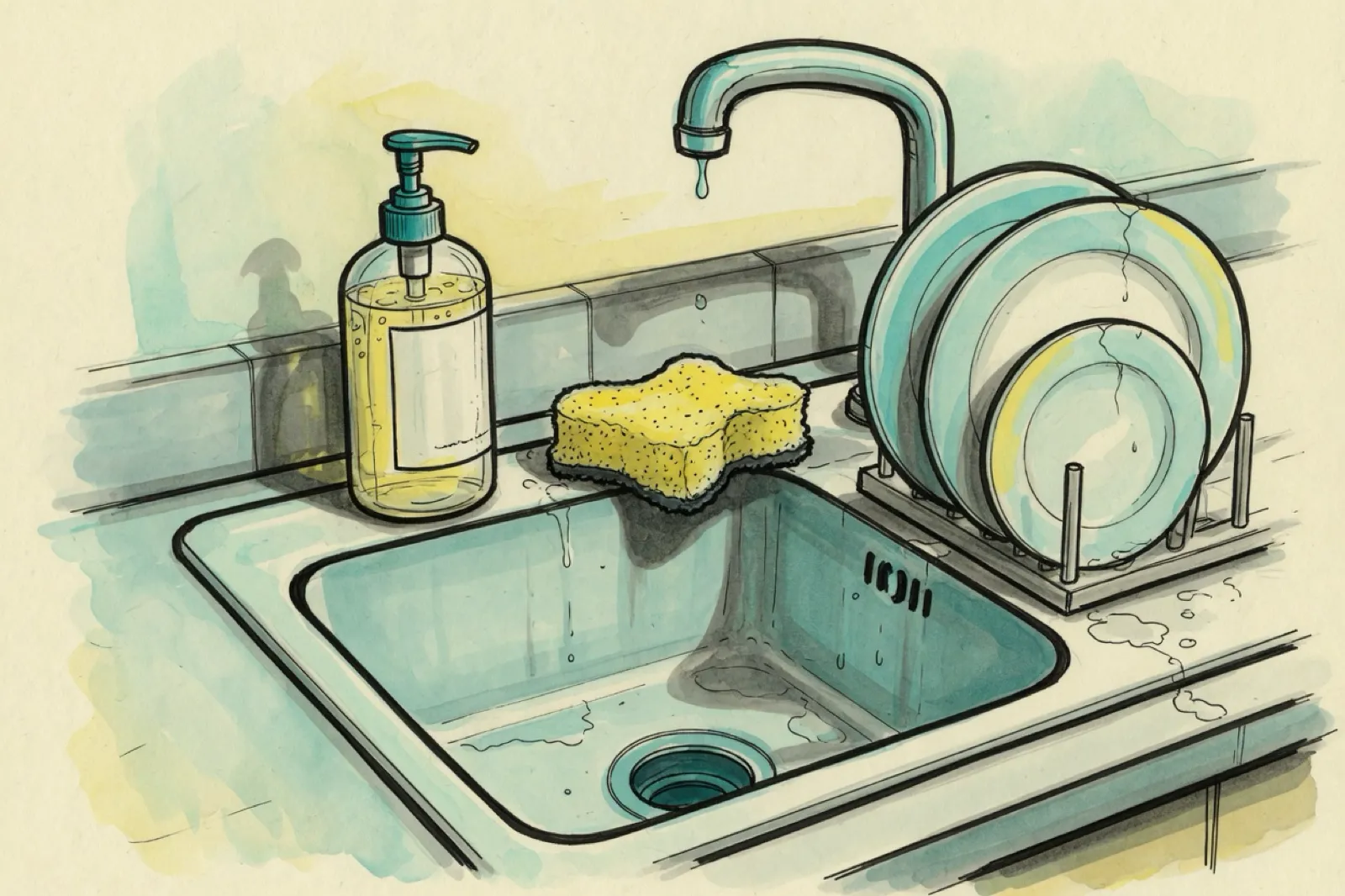
Washing dishes is hot water, grease, and a bottle under the sink you barely look at. That bottle still spends a lot of evenings in your hands, and a film of it can stay on the plates if you rinse the way most people rinse, which is fast.
Your dish soap is not poisoning you. A lot of conventional formulas do carry irritants, fragrance chemicals, and process contaminants that do nothing for clean plates. Daily contact with your skin, plus whatever is left on the plate, is a low-drama exposure worth shrinking.
What ends up in the bottle
Read a few labels and the same families of ingredients keep showing up.
Sodium lauryl sulfate (SLS) and its relatives cut grease well. They also strip the oils out of your skin. If you have eczema, sensitive hands, or you already wash them a lot, that shows up as dryness, cracking, and irritation. Good degreaser, rough on your skin barrier if you live in it.
“Fragrance” or “parfum” on a label can stand for dozens of compounds, and manufacturers do not have to list them one by one. Some of those ingredients can include phthalates, used as solvents or carriers. Phthalates as a class have been studied for endocrine activity. Dish soap is not the only place you meet them, so adding one more daily source for the sake of a lemon scent is optional.
Water-based soap needs something to keep microbes from growing in the bottle. Some preservative systems, and some of the older “antibacterial” actives, have drawn more concern than others. Triclosan is the famous one. It was used widely in soaps marketed as antibacterial until 2016, when the FDA banned it from consumer antiseptic wash products because companies could not show it beat plain soap and water for routine use. That shelf is long gone, but the lesson stuck with me. Antimicrobial marketing does not make a kitchen cleaner.
Ethoxylated ingredients are the ones with “eth” in the name, plus the PEG compounds and sodium laureth sulfate. They can carry 1,4-dioxane as a leftover from manufacturing rather than as an added ingredient. EPA classifies 1,4-dioxane as likely to be carcinogenic to humans by all routes of exposure. Levels in finished consumer products are usually low, and regulators have paid far more attention to drinking water and industrial sites than to your sponge. It is still a contaminant you can cut down on by picking simpler formulas and products that test for it or disclose low levels.
A few preservatives work by slowly releasing small amounts of formaldehyde to keep bacteria down in the bottle. That is a very different exposure from industrial formaldehyde, but people with formaldehyde sensitivity or chronic dermatitis often do better without them.
None of this turns every blue bottle into a hazard label. Dose, frequency, and how well you rinse all matter. What bothers me is the unnecessary daily contact with chemicals that do nothing for your health and add little to the cleaning that a simpler surfactant system already handles.
Residue is the boring problem
Hands matter, and so do plates.
If the soap does not rinse off fully, a thin film stays on bowls, glasses, and baby bottles, and then you eat and drink off that film. Nobody is measuring residual surfactant at home with a lab kit. They are rushing through the sink before bed. Hot water, enough time under the tap, and a real scrub beat worrying about which brand you bought.
A dishwasher changes the math. Higher temperature, longer rinse cycles, and your hands never touch the concentrate. Hand-washing a greasy pan with a heavily fragranced formula is where the exposure stacks up: wet skin, friction, steam, then an imperfect rinse.
I care more about that pattern than about any single ingredient scare post.
Green bottles have the same problems
Swapping brands without reading the label is how people end up with a green bottle, the same fragrance problem, and a higher price.
Plant-derived surfactants can still irritate. Essential oils can still sensitize skin. “Free and clear” marketing beats a perfume cloud, but free of what? Look for short ingredient lists, fragrance-free where you can get it, and claims specific enough that you can check them, rather than a leaf on the label.
I also do not need a $40 concentrate that promises to clean the whole house when a plain, cheap, fragrance-free dish liquid and a box of baking soda already handle 90% of kitchen messes. I buy the category rather than the cult brand. Plant-based or simple synthetic surfactants, no dyes I do not need, no heavy scent, and preservatives named clearly enough that I can look them up.
What actually cleans the plate
Soap is a tool for grease and food film. Mechanical action does more than people admit.
Baking soda is a mild abrasive and a deodorizer. A paste on a pan, a sprinkle in a greasy sink, or a soak for a stained mug cuts the need to double-soap everything. Vinegar helps with mineral film and some odors, though it is not a magic sterilizer and should not be mixed casually with anything containing bleach. Hot water and time still win most arguments.
If you want antibacterial drama for a cutting board after raw meat, heat, a dedicated scrub, and proper food-safety habits do more than a “kills 99.9%” claim on the soap you use for everyday plates.
What I’d actually do
You wash dishes often enough that small choices in the bottle add up. I treat it like the rest of the stuff under the sink. Cut the junk, keep the function, skip the purity spiral.
Start with fragrance-free, since that one switch drops a large black-box mixture out of the bottle in a single move. If you miss the scent, open a window. Your plates do not need to smell like a candle. From there, prefer short labels: fewer dyes, fewer marketing actives, fewer “boosters” you cannot name. A plant-based surfactant system is fine, and so is a plain conventional one without perfume.
Then rinse like you mean it. Hot water, a full pass under the stream, no greasy film left behind, and a clean cloth or microfiber for the glasses if spots bother you. Residue is the one exposure here you control without buying anything. Let baking soda do the scrubbing where you would otherwise reach for more soap, a paste for stuck food and stainless, with soap only where grease needs a surfactant. Less product, same clean plate.
Skip the antibacterial dish soap for routine use. Plain soap and mechanical cleaning handle daily dishes, and stronger disinfection belongs in the situations that call for it, with products meant for that job. Be just as skeptical of the green aisle. “Natural,” “eco,” and “non-toxic” are sales words unless the label is short and the claims are specific. What you want is a bottle that cuts grease, does not wreck your hands, and leaves as little mystery chemistry on the plate as possible.
Sources
- U.S. Food and Drug Administration. FDA issues final rule on safety and effectiveness of antibacterial soaps (triclosan and related consumer antiseptic wash rule, 2016).
- U.S. Environmental Protection Agency. Technical Fact Sheet: 1,4-Dioxane; see also EPA IRIS assessments classifying 1,4-dioxane as likely carcinogenic to humans.
- California Department of Toxic Substances Control. 1,4-Dioxane in Personal Care and Cleaning Products (exposure pathways including dishwashing and product testing summaries).
- Environmental Working Group. EWG’s Guide to Healthy Cleaning and Skin Deep entries on 1,4-dioxane (ingredient hazard framing; use as a starting map, not gospel).
- Centers for Disease Control and Prevention / NIOSH. Chemical hazard information on skin and respiratory irritation for common industrial surfactants and related compounds (occupational data is a stricter exposure setting than home use, but it flags irritant potential).