
The Restoration of the Great American Experiment
America was never a finished product. It was a wager about where wealth comes from: the creative powers of the human mind. That wager can be rerun.
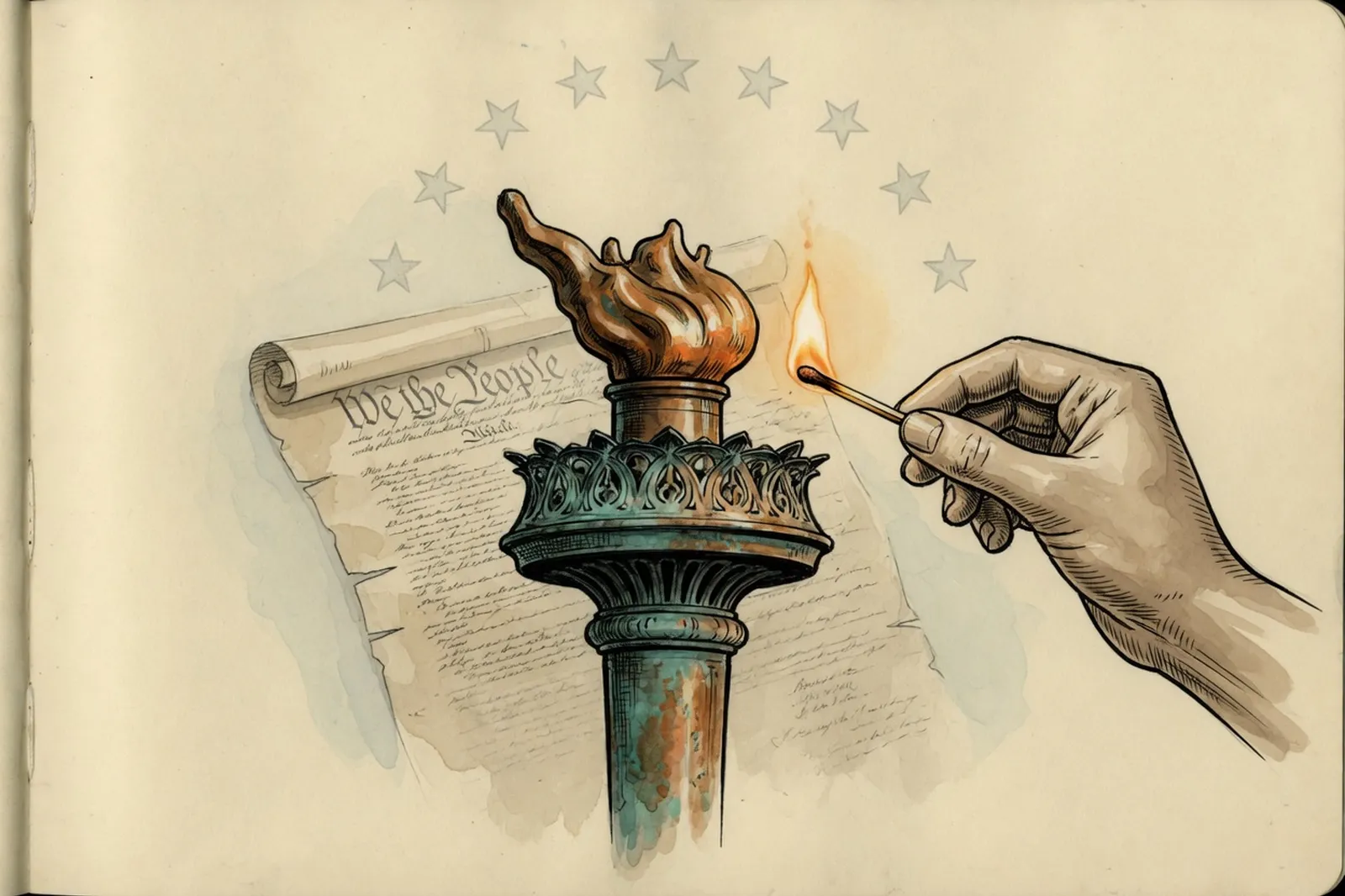
The men who built this country did not call it a nation. They called it an experiment, and they meant the word literally.
Washington, in the first inaugural address ever given, said the “sacred fire of liberty” and the fate of republican government itself were “staked on the experiment entrusted to the hands of the American people.” Franklin, walking out of the Constitutional Convention, was asked what kind of government they had produced. “A republic,” he said, “if you can keep it.” Lincoln stood on a battlefield and called the war a test of whether any nation so conceived “can long endure.”
But ask what the experiment was actually testing and almost everyone gives the wrong answer. Voting? Republics had voted before, and died voting. Markets? Empires have run markets since Babylon. The real hypothesis was deeper, and it was economic, and until you see it you cannot understand what made America different, why it is being strangled, or what restoring it would mean.
The hypothesis was this: wealth comes from the creative powers of the human mind, and a society organized to cherish those powers will outrun every empire on earth.
The oldest system on earth
To see what America broke from, look at what came before, because it is all one thing.
Babylon, Persia, Rome, Byzantium, Venice, the British Empire: the costumes change, the operating system doesn’t. An imperial system is a machine for extraction. Buy cheap, sell dear, loot the provinces, keep the subjects docile, and above all keep them fixed, because the empire’s ledger only balances if the peasant’s grandson is still a peasant. Empire is, at bottom, a theory of man: he is livestock. A mouth to feed, a muscle to spend, a unit to count.
The British Empire did not invent this. It inherited it from Rome by way of Venice and gave it double-entry bookkeeping. And it gave it something else: a philosophy dressed as science. Adam Smith, 1759: “To man is allotted a much humbler department.” Hunger, thirst, appetite, the love of pleasure and the dread of pain — these, said Smith, are what actually govern us, and the sum of all that grubbing gets blessed, somehow, by an invisible hand. His predecessor Mandeville said it with fewer manners: society is a beehive, private vices make public benefits. Man the insect. Man the particle.
Understand this and you understand why “free trade” was the empire’s favorite export. A theory that says nobody should ever deliberately build anything is a wonderful theory to sell to your colonies. It keeps them shipping raw materials out and buying finished goods back forever. It is the economics of the plantation gate, written in the language of liberty.
Hamilton’s wager
Against all of that, in 1791, Alexander Hamilton put a different theory of man on the table, in a state paper almost no American student is ever assigned: the Report on Manufactures.
The young republic was being told — by London, and by its own Virginia gentlemen — to stay agricultural. Ship tobacco, import tools, know your place in the imperial division of labor. Hamilton’s answer was that a nation of farmers alone would remain a colony with a flag, and buried in his argument is the sentence that contains the whole American system: “To cherish and stimulate the activity of the human mind, by multiplying the objects of enterprise, is not among the least considerable of the expedients, by which the wealth of a nation may be promoted.”
Read that again. The wealth of the nation is promoted by stimulating the activity of the mind. Not by hoarding gold, not by cheap labor, not by the invisible blessing of aggregated appetites. Manufacturing mattered to Hamilton because it multiplies the kinds of work a mind can do — it gives the tinkerer, the mechanic, the chemist, the odd obsessive kid a place to become what he is. Public credit, a national bank, protection for infant industry: all of it was plumbing for one purpose, maximizing the number of minds applied creatively to nature.
Here is the input-output table of the American system, and it fits in one line. Input: creative ideas. Output: better creative ideas. A discovery becomes a technology, the technology raises the productive powers of labor, better-fed and better-schooled people produce more discoveries, and the loop closes at a higher level each time. The universe rewards this because the universe is built for it — it is not a clock running down but a creation still creating, and man is the only creature that participates on purpose: the only animal that turns rock into soil, soil into cities, cities into starships. Vernadsky mapped it as three nested worlds — the non-living, the living, and the world remade by thought — each transforming the one below. Economics, properly understood, is the science of that third world. Everything else is accounting.
Lincoln’s economist, Henry Carey, put the choice plainly: two systems are before the world, one seeking to pauperize and brutalize, the other “elevating while equalizing the condition of man throughout the world” — the English system and the American. That is the actual axis of the last two and a half centuries. Not left versus right. Extraction versus creation.
The experimental results
This is not philosophy you have to take on faith. The experiment ran, repeatedly, and the lab notebook is called American history.
Hamilton’s program turned thirteen indebted colonies into a solvent, building nation inside a generation. John Quincy Adams and Clay drove roads and canals through wilderness. Lincoln, in the middle of a civil war, signed the land-grant colleges, the Homestead Act, the transcontinental railroad, and a National Academy of Sciences — a man fighting for the nation’s life spending its credit on its mind. The same policy current gave you rural electrification, the arsenal that broke fascism, the interstate system, and a species that walked on the Moon because a republic decided to go.
Every run of the program produced a leap. And the leaps produced the one metric that cannot be propagandized: direction of travel. For two centuries, people have crossed deserts and oceans to get in. Nobody builds a raft to reach an empire’s plantation. The walls that matter in history are the ones built to keep people in, and America never needed one.
Even the correction of our great sin ran on the system’s own fuel. Frederick Douglass — a man the imperial theory classified as livestock — got hold of a book, which is exactly what the theory forbids, and the mind did the rest. He read the Constitution and called it a “glorious liberty document,” then used it as an indictment. The slaveholder and the empire share an enemy, and it is the activity of the human mind.
How the experiment got contaminated
So what happened? The oldest system on earth did what it always does: it came back, and it came back wearing two masks.
One mask preaches the hive. Let every particle bounce after its own appetite, deliberately build nothing, and the statistics will bless the aggregate. Under that banner we financialized. After 1971 the dollar was cut loose, and the ledger replaced the workshop as the center of the economy. Factory towns learned what “efficiency” means in the imperial dictionary. We became the thing Hamilton warned we would be: a raw-materials producer and a financial center, importing our finished goods, our medicines, our machine tools — a colony again, with better marketing. And the busts came like tides, each one destroying real, physical, painfully accumulated productive power.
The other mask preaches the plan: hand the machine to the experts, and the deterministic clockwork will grind out fairness. We bought a domestic flavor of that too — an administrative state that regulates as if the economy were a machine to be held in equilibrium rather than a mind to be unleashed.
Notice what both masks agree on. Man is not a creator. He is a particle to be aggregated or a cog to be planned. And notice the quieter contamination that made both possible: the schools stopped teaching the source code. Hamilton’s reports, Carey’s books, the actual principles of the system — gone from the curriculum. A nation that cannot name its own operating system will run whatever software the empire installs. We even learned to worship equilibrium itself — as if balanced books, rather than built things, were the purpose of a national economy. No great American project from the Erie Canal to Apollo ever penciled out in advance on a spreadsheet. Spreadsheets measure the geometry that exists. Building changes the geometry.
Restoration is not nostalgia
The sentimentalists want 1955 back; that is a costume party. The doomers say the experiment failed and it’s time for “something new,” by which they always mean something ancient: management by the enlightened few, the imperial default with a fresh interface.
Restoration means something precise: rerun the experiment. Rebuild the industrial base, not as nostalgia for smokestacks but because manufacturing is where minds meet matter, the multiplication of the objects of enterprise. Point public credit at production again — at power plants, shipyards, fusion, water, machine tools — instead of at bubbles. Put the frontier back where it belongs, which is above us; a republic reaching for the Moon and Mars is not spending money, it is doing the one thing that has always paid for everything else. Teach children the actual source code, so the next generation can tell the American system from the imperial one on sight.
And understand the deepest reason this program and only this program works: creativity cannot be compelled. It is the one economic input that cannot be extracted at gunpoint, taxed into existence, or planned into a schedule. It is voluntary, always. That is why freedom is not a luxury the American system affords, it is the power source the system runs on. Every real discovery arrives the same way, in some free mind that had room to say “I never thought of it that way before” — and in that instant the geometry of the possible changes shape, and no empire’s plan and no market’s statistics saw it coming.
A republic of free, creative minds is the only anti-entropic machine ever built. That is what the founders staked everything on, whether they had the physics for it or not.
The lab is not closed
Every generation gets told the experiment is over. The British were sure in 1776. The Confederacy bet on it. The Soviets built a foreign policy on it, and their flag came down instead.
The experiment does not fail when times get hard. It fails the day Americans accept the imperial theory of themselves — mouths, muscles, particles, cogs — and hand the creative work of self-government to whatever anointed class is offering to manage the livestock this century.
Franklin’s answer was conditional on purpose. A republic, if you can keep it. Not if the experts can keep it. You.
The torch is not out. It is sitting there, waiting for a hand.