
Socialism Is the Pitch. Communism Is the Product.
Every communist state in history called itself socialist. The deeper trick: it also sold itself as empire's enemy — while running empire's operating system.
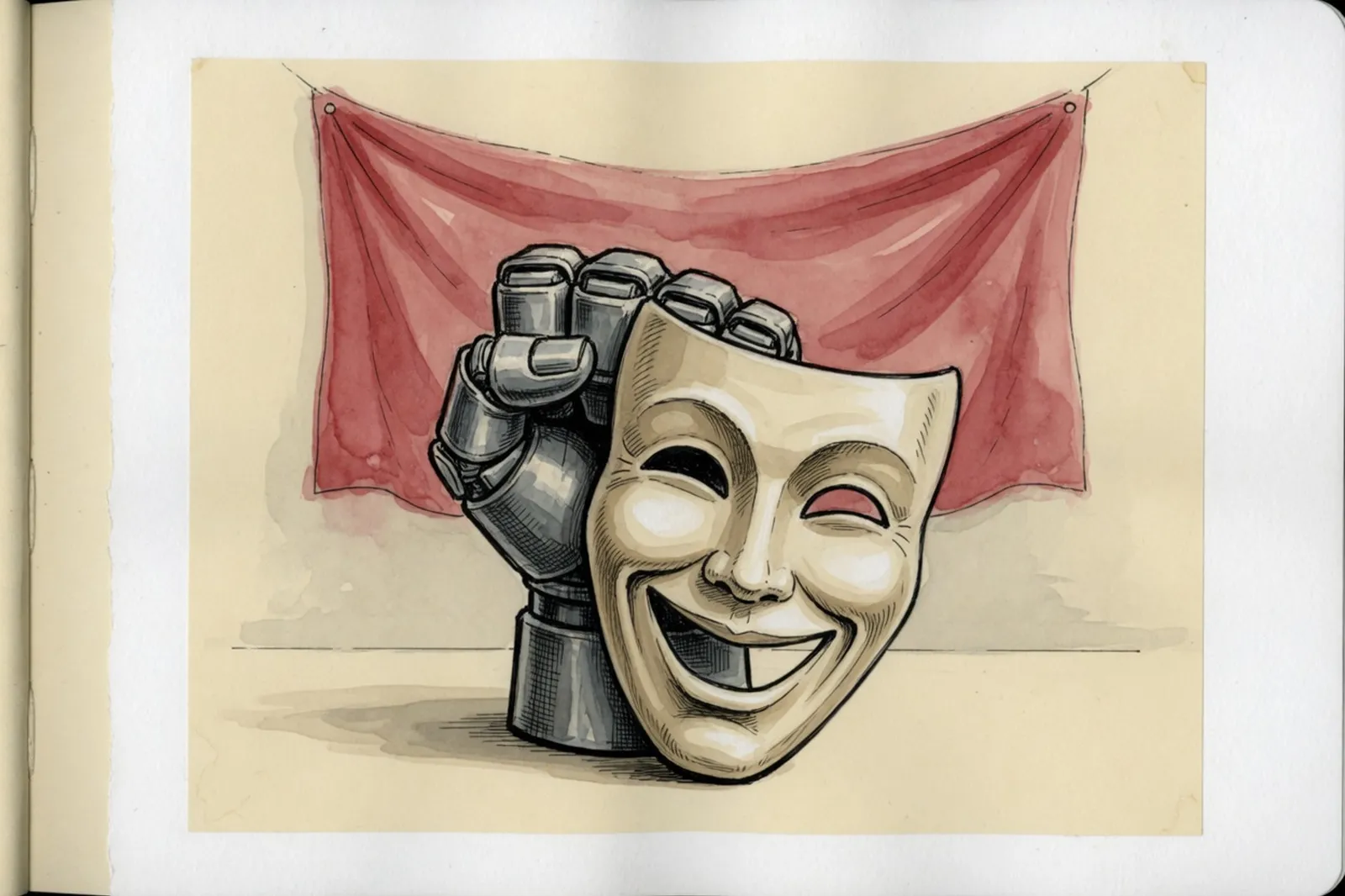
Every communist state in history called itself socialist.
The Union of Soviet Socialist Republics. East Germany, run by the Socialist Unity Party. The Socialist Republic of Vietnam. China, constitutionally a socialist state to this day. Not one of them put “communism” on the door. That is not my framing; it is Marx’s. In his own schema, socialism is the transitional stage — the state seizes the means of production and holds total power “temporarily,” on behalf of the workers, until it withers away into the communist paradise. Lenin said it without blinking: the goal of socialism is communism.
The state never withers. The temporary stage is the product. And a century and roughly one hundred million corpses later, the same two-step is still running: sell socialism, deliver communism, and when it collapses, announce that it was never real socialism. Somehow the real one is always the next one.
That is the surface deception, and it is bad enough. But there is a deeper masquerade underneath it, and once you see it, the whole twentieth century snaps into focus.
The pitch and the switch
The pitch is always mercy. Healthcare, bread, dignity, the worker, the poor. Who argues with mercy?
The switch is always ownership. Track what actually transfers in every socialist revolution: not wealth to the poor, but decision-making power to the state. Your farm, your labor, your speech, your children’s schooling. The poor stay poor. The party gets the keys.
When challenged, the modern pitch hides behind Denmark — cozy, Nordic, safe. Denmark’s own prime minister got so tired of this he corrected it publicly at Harvard: Denmark “is far from a socialist planned economy. Denmark is a market economy.” The costume doesn’t even fit the country it’s borrowed from.
The deeper masquerade
Communism’s greatest disguise was never the word “socialism.” It was posing as the enemy of the very system that produced it.
Ask where Marx actually did his work. Not in America, studying the young republic that was industrializing farm boys into engineers. He sat in London, in the reading room of the British Museum, dissecting the British imperial economy — the sweatshops, the enclosures, the East India ledgers — and then he named that thing “capitalism” and declared it the final stage of history before his revolution. The word itself was popularized by the system’s enemies as a label for what they saw in Britain.
But there were never just two systems on the table, Britain’s and Marx’s. There was a third, and Marx knew it, because he attacked it by name. Henry Carey — Lincoln’s economic adviser, the leading American System economist of his century — argued that there is no inherent war between labor and capital, because wealth does not come from squeezing either one; it comes from improving the productive powers of both through science, technology, and the development of the human mind. Carey said two systems were before the world: one seeking to pauperize and brutalize man, the other to elevate him. Marx sneered at Carey precisely because harmony of interests destroys the class-war premise. If the American System is true, Marxism is unnecessary. So it had to be dismissed, then, and it has to be hidden from you, now.
Here is the actual taxonomy. The British imperial system comes in two flavors. Flavor one: the free-trade hive — every particle bounces after its own appetite, nobody deliberately builds anything, and the statistics of the swarm allegedly bless the aggregate. Flavor two: the socialist clockwork — hand the machine to planners, and determinism will grind out fairness. Adam Smith’s bee and Marx’s cog. They market themselves as mortal enemies, and they share the axiom that matters: man is not a creator. He is livestock to be aggregated or livestock to be planned.
Empires can live with either flavor; they have run both, sometimes simultaneously in different provinces. The one thing the imperial order has never been able to live with is the third system — a republic that industrializes the creative powers of ordinary minds. Which is why you were taught that your only choices are the hive and the clock.
The track record
Before the mechanism, the record — because the experiment has been run on every continent, every culture, every scale.
Russia: collectivization, engineered famine in Ukraine that starved millions, the Gulag. China: the Great Leap Forward killed somewhere between fifteen and forty-five million people, and the uncertainty is itself the indictment — the regime did not count its own dead. Cambodia: roughly a quarter of the population erased in four years, starting with anyone who wore glasses. North Korea: a famine state with concentration camps, visible from orbit as a black hole between two seas of light. Venezuela: the largest proven oil reserves on Earth, once among the richest countries in Latin America, now the source of nearly eight million refugees.
And history, unusually generous, supplied controlled trials. One people, one language, split down the middle: East and West Germany. North and South Korea. One variable changed. Both times the socialist half became a prison and the other half became a miracle, and both times the wall’s guns pointed inward. No nation on the American model has ever needed to shoot its citizens for leaving.
Why it fails: the clockwork lie
The failures were not bad luck, and they were not the wrong men. They follow from the physics smuggled in at the foundation.
Marxist planning treats the economy as Newton treated the heavens: a machine of bodies obeying fixed laws, such that if you know the initial conditions, you can compute the future. Feed in the tonnages, turn the crank, print the five-year plan. The Soviets employed buildings full of mathematical economists doing exactly this — deriving the equations of the great machine — and the machine failed every single time, because an economy is not a machine, for one reason that cannot be patched: a machine cannot have a new idea.
Leibniz saw the flaw in the clockwork universe three centuries ago: a clock only runs down; even Newton conceded God would have to intervene and rewind it. A clockwork economy is the same. It can only redistribute and deplete what exists at the moment the plan is written. Everything actually new — the process that turns sand into semiconductors, the seed that quadruples the harvest — enters the economy through an event no equation contains: a human being saying “I never thought of it that way before.”
There is a beautiful way to see what kind of event that is. Take any ball-like solid — a cube, a soccer ball, any faceted lump — and count its corners, edges, and faces: corners minus edges plus faces always equals two. Always. You can rearrange the facets forever, shave corners, add a thousand faces; the geometry constrains every possible configuration to the same total. That is an economy under a fixed level of knowledge: rearrange it however you like, the constraint holds. Now punch a hole through the ball and join the surfaces into a donut. Count again: the total is zero. New shape, new rules — curves that could never exist before now fit; a map that needed four colors now needs seven. Nothing on the old surface predicted the new one. That leap — discontinuous, unforecastable, geometry-changing — is what a discovery is. A plan is a fixed geometry. A discovery changes the geometry. Therefore the plan is obsolete the moment anyone in the economy truly thinks, which is why, sooner or later, the planners must forbid thinking.
And here is the fact that seals it: creativity is voluntary. It is the one economic input that cannot be extracted at gunpoint. You can force a man to dig, so command economies dig magnificently. You cannot force him to discover. The Soviet peasant, allotted a private garden plot, farmed it with devotion and farmed the collective fields with theatrical laziness — and those plots, a sliver of the land, fed the country. Terror can meet a quota of wheat. It has never once produced a Wright brothers.
The slavery connection
Now strip slavery to its mechanism, because the imagery hides the system. Slavery is the imperial theory of man made law: a human being reclassified as livestock — a muscle and a mouth, an input owned, allocated, and spent by someone else, forbidden to quit, forbidden to leave, forbidden to keep what he produces.
Every empire has run it, from Babylon’s brick pits to Rome’s latifundia to the plantation. And communism, the self-declared enemy of exploitation, did not abolish that system. It perfected it. When the state owns all means of production, it owns the original means of production — your labor. The Gulag was a slave economy with output quotas, human beings booked as disposable inputs against mine and railway targets. China’s laogai — “reform through labor” — was the same instrument. North Korea runs it today. And the Soviet collective farm was serfdom rebooted: peasants were denied the internal passports needed to leave the land until 1974. Not 1874. 1974.
Look at what slavery always attacks first, though, because this is the tell that unifies everything. It was a crime to teach Frederick Douglass to read. His master explained why with perfect candor: learning would forever unfit him to be a slave. The system’s survival required the suppression of exactly one thing — the activity of his mind. Douglass got a book anyway, and the mind did the rest, all the way to the lecture halls of the world. The overseer and the commissar reach for the same whip at the same moment: when they catch a man thinking. A creative mind cannot be planned, cannot be counted as livestock, generates futures no master’s geometry contains. That is why the plantation banned literacy and the politburo banned everything else.
Communism does not end the plantation. It nationalizes it — and prints heroic posters of the overseer.
The technology connection
Technology is where the whole fraud comes to a point, in three steps.
First: Marx built his economics blind to it. In his value theory, only raw labor-hours create value; the machine — which is congealed human creativity, a discovery frozen into metal — creates nothing. From this he derived his famous doom-spiral: more machinery, falling rate of profit, inevitable collapse of capitalism. Reality ran the other way, in every decade since: technology is precisely what raises the productive powers of labor and the wealth of nations. The founder of “scientific socialism” got the science of wealth exactly backwards, and his heirs governed accordingly — economies that could copy a bomb, reverse-engineer a factory, steal a blueprint, and in seventy years never originate the future even once. Imitation is what remains when you’ve built a society that punishes the “aha.”
Second: the excuse is being rebooted. Planning failed, the new pitch goes, only because planners lacked compute — with AI and total data, we can finally run the machine scientifically. The Soviets chased this with a national computer network in the 1960s; Allende’s Chile built a futuristic control room in the 1970s; both eras’ faith outlived their systems. It fails at the same wall, forever: a computer, however large, extrapolates the existing geometry. No dataset contains the idea that does not exist yet. The plan is a map of the ball; the future is the donut.
Third, and darkest: what technology can do for the clockwork state is enforce it. Twentieth-century totalitarianism had a scaling problem — informants and paper, and still the Stasi couldn’t see everything. That problem is solved. Ubiquitous cameras with facial recognition, social credit scores, speech filtered at the platform layer, money that is programmable and switch-off-able. In the American system, technology is the mind’s fingerprint on nature — each machine a frozen discovery that frees labor for higher work. In the other system, the same technology becomes the perfected overseer. Slavery 1.0 needed chains and whips. The upgrade needs a database and a kill switch on your wallet. Same theory of man. Better hardware.
That is why this is not a Cold War rerun. The economics of the clockwork state are as dead as ever. The enforcement of it has never been cheaper.
How to spot the mask
Don’t read hearts. Read what a system does to the mind.
Does it multiply the objects of enterprise — more ways for more minds to build, discover, own, and rise? Or does it ration them, license them, plan them, and treat the unplanned idea as a threat? Whatever the label on the door, watch for the checklist: centralize ownership, control speech, control money, take the children’s education, and promise that the concentrated power is temporary.
And refuse the fake menu. The choice was never the hive or the clock — two flavors of the same imperial kitchen, both built on man-as-livestock. There is a third system. It industrialized a wilderness, freed its slaves with its own founding weapons, fed the world, and put footprints on the Moon, and it did all that for one reason: it is the only system in history organized around man as what he actually is — a creator.
One hundred million people paid the tuition for this lesson, and it fits in a sentence: when someone offers to run your life in exchange for paradise, the paradise is negotiable. The running of your life is not.