
Morning Sunlight
Morning sunlight is free, takes minutes, and sets the master clock that runs sleep, mood, and energy. Get it early, outdoors.
Morning sunlight can move your sleep, mood, and energy more than most of the gadgets on your shelf. It’s free and it takes a few minutes. What matters is when you get it.
For the last few years I’ve been paying closer attention to how the world around us shapes the nervous system. Light is one of the strongest drivers. Get the right kind at the right time, and a lot of mental and physical health gets easier. Miss it for weeks, and you can feel “off” without knowing why.
Your master clock
Inside your brain, just above the optic chiasm at the base of the hypothalamus, sits the suprachiasmatic nucleus (SCN). It’s your master biological clock. It helps set the rhythm of nearly every cell in your body: when to be alert, when to be hungry, when to release certain hormones, when to feel sleepy.
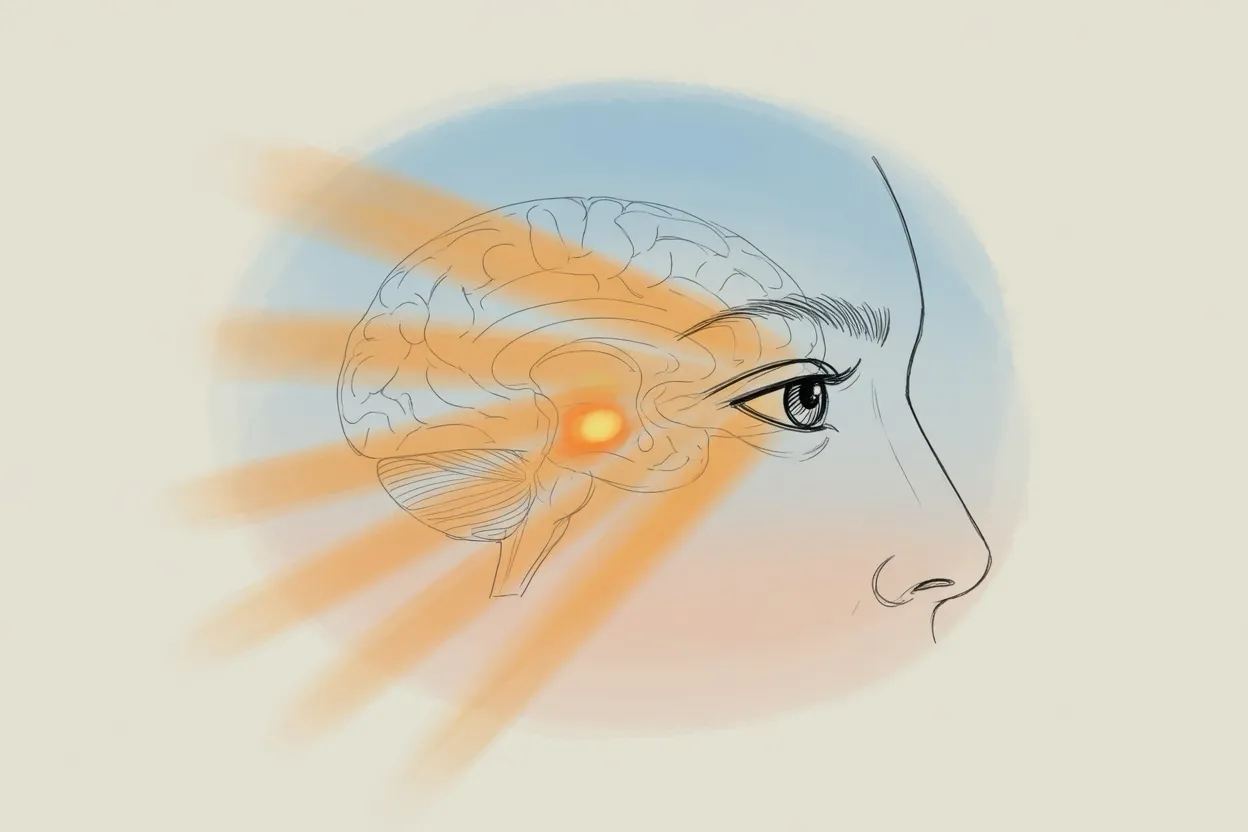
Light through the eyes is the main cue that sets the SCN each day.
The clock gets set through your eyes. Certain wavelengths of light hit specialized retinal neurons that talk directly to the SCN, and that’s the “day has started” signal. The light that hits those neurons hardest is the low-angle sunlight of early morning.
From there it starts a chain you can feel. Morning light helps your cortisol rise on time. We usually hear about cortisol only as a stress hormone, but that morning pulse helps with alertness and focus. Skip outdoor light for days and the timing can drift, which is one path to that “tired and wired” evening.
The same morning light also helps set when melatonin rises later that night. Getting sun early is one of the cheapest levers I know for falling asleep and staying asleep.
Mood, serotonin, and vitamin D
Morning light can help mood too. Sunlight is a strong stimulus for serotonin, a neurotransmitter tied to calm and well-being, and low serotonin shows up in many clinical contexts around depression and anxiety. Morning sun will not replace treatment when you need it. It’s a simple input a lot of people underuse.
Then there’s vitamin D. You can get some from food, but the most efficient production still comes from UV on skin. Vitamin D acts like a steroid hormone and matters for immune function, bone health, and more.
Setting your clock and making vitamin D are related goals, not the same goal. Morning outdoor light is worth doing even when the UV is too weak for much vitamin D. Don’t skip the walk because it isn’t “vitamin hour.”
What I’d actually do
This is simple, and I do some version of it most days. Get outside within 30–60 minutes of waking. The timing matters. Early signal, early day.
On a clear morning, 5–10 minutes is enough. Don’t stare at the sun. Face the general direction of the light and let it reach your eyes. When it’s cloudy, give it 15–20 minutes instead. Clouds still pass enough of the light you need, you just need longer.
Leave the sunglasses off, and don’t try to do this through glass. Sunglasses block wavelengths you want, and windows and windshields filter a lot of the outdoor spectrum. Step outside when you can. Then, if your day allows it, take another 10 minutes in the late afternoon. As the sun drops, that second dose helps lock in the day–night signal.
Weather, latitude, and work schedules make this harder for some people. If you truly cannot get outside, bright artificial light is a distant second-best. Outdoor light is still the goal.
Try this for five days in a row. Don’t change anything else. Just get morning sunlight first. Notice your energy in the morning, how easily you fall asleep, and whether mood or focus shifts during the day.
Sources
- Berson, D. M., Dunn, F. A., & Takao, M. (2002). Phototransduction by retinal ganglion cells that set the circadian clock. Science, 295(5557), 1070–1073. https://doi.org/10.1126/science.1067262
- Leproult, R., Colecchia, E. F., L’Hermite-Balériaux, M., & Van Cauter, E. (2001). Transition from dim to bright light in the morning induces an immediate elevation of cortisol levels. Journal of Clinical Endocrinology & Metabolism, 86(1), 151–157. https://doi.org/10.1210/jcem.86.1.7102
- Wright, K. P., Jr., et al. (2013). Entrainment of the human circadian clock to the natural light-dark cycle. Current Biology, 23(16), 1554–1558. https://doi.org/10.1016/j.cub.2013.06.039