
The Brain Regions We Evolved Last Age First
Human brains grew fast in prefrontal circuits for planning and control. Those same late-evolved regions show the strongest age-related decline on MRI.
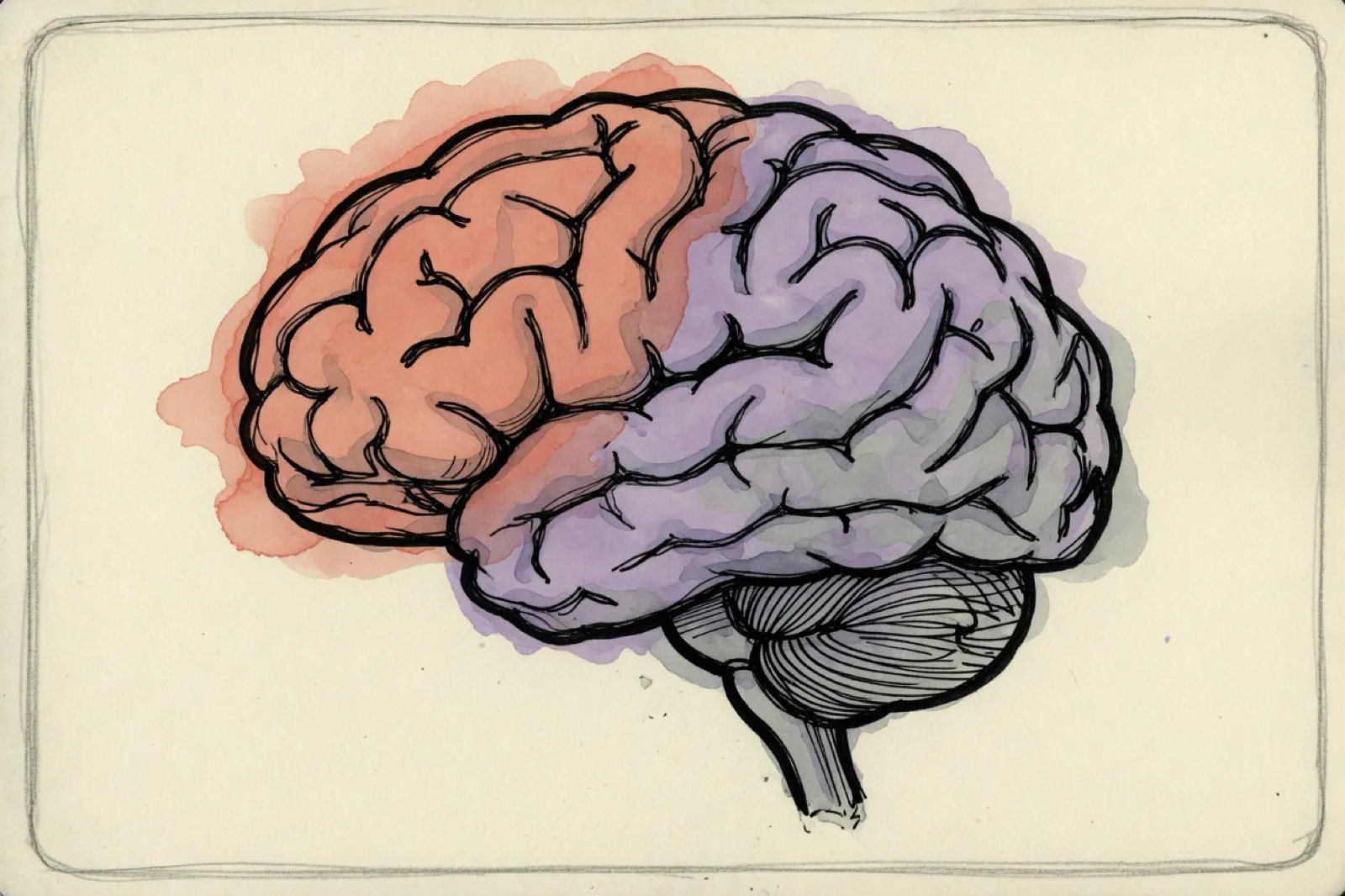
Human intelligence has a bill attached. The brain tissue we piled on after we split from other great apes is also the tissue that thins hardest with age.
That is the plain reading of a 2024 comparative MRI study, covered in Nature, that put human and chimpanzee brain aging side by side. It backs an old developmental idea with new comparative data: last in, first out. The regions that expanded late in evolution, and that finish maturing late in a human life, are among the first to show clear age-related gray matter decline.
What the scans showed
Sam Vickery and colleagues compared hundreds of structural MRI scans across species. Roughly 480 human brains and 189 chimpanzee brains, plus smaller samples from other primates for evolutionary context. They mapped which cortical territories expanded most along the path from ape to human, then asked where gray matter shrinks most as each species ages.
In humans, the answer clustered hard in higher-order frontal tissue: ventral prefrontal and orbitofrontal cortex, the circuits tied to decision-making, self-control, social judgment, and flexible planning. Chimpanzees lose gray matter with age too, but the tight coupling between recent expansion and aging vulnerability did not show up the same way. The tissue that made us more human sits where the wear starts.
None of this is a dementia diagnosis. It is a population pattern visible on imaging long before anyone fails a memory clinic. Medical coverage of the work noted measurable decline signals that can start showing in adulthood, with frontal circuits among the hardest hit later. Clinicians already see the everyday version of this. Planning, impulse control, and mental flexibility are not invincible just because they feel like “who you are.”
Last in, first out
Neuroscientists have long noticed that human prefrontal cortex is late to finish. Myelination and network refinement keep going into the twenties for many people. The evolutionary story rhymes with the developmental one.
After humans and chimpanzees split more than six million years ago, our brains rapidly expanded the tissue that supports executive control and related higher functions. Felix Hoffstaedter and coauthors on this line of work have put the implication cleanly: the latest evolutionary upgrades appear among the most age-sensitive. Build it late, lose it early.
I find that framing useful because it describes a trade. We bought a bigger, more flexible frontal system. That system is metabolically expensive, finishes wiring late, and sits in the path of age-related atrophy more than many older, more conserved circuits.
If you have ever watched a sharp older relative stay fluent on stories from decades ago while struggling more with new plans, multitasking, or social filtering, you have seen a soft version of this pattern in real life. Last-in circuits carry a lot of what we call personality and judgment. They are also high-maintenance.
No pill comes out of this
Longevity marketing wants a single villain and a single fix. What this study offers is a map of where human aging hits hardest, plus a reminder that those regions are the ones we ask the most of at work and at home. There is no supplement, gene, or scanner subscription at the end of it.
Two things follow for me.
The first is to treat the boring inputs as non-negotiable, because they are what protect the circuits that mature late. Sleep debt, chronic metabolic strain, social isolation, and total inactivity stop sounding like vague “lifestyle” talk once the tissue at risk is the tissue for planning and control. Frontal networks are energy-hungry and experience-dependent. They do better when the whole system is less inflamed, better oxygenated, and used regularly for real cognitive and social work.
The second is to stop treating cognitive aging as only a memory problem. Memory matters. So do inhibition, set-shifting, and the ability to update a plan when the world changes. Those are prefrontal jobs. If your only brain-health metric is a word-list score or a consumer “brain age” app, you are watching one dial on a big board.
Walking and sleeping will not freeze MRI gray matter at 30. Aging is real, and species comparisons make that clearer rather than softer. The useful move is to stop underinvesting in the systems that evolution made both powerful and fragile.
What I’d actually do
No nootropic stack required. Protect late-maturing, high-demand frontal circuits the way you protect any expensive system: keep the power clean, use it regularly, and avoid chronic abuse.
Sleep comes first, and I mean sleep as maintenance rather than a nice-to-have. Consistent duration and timing are the whole ask. Sleep is when the brain clears waste and consolidates the kinds of learning frontal networks depend on, so chronic short sleep is a tax on the exact faculties this research flags. Movement is next, for equally unglamorous reasons. Regular aerobic work and resistance training support vascular health, insulin sensitivity, and mood regulation. Blood flow and metabolic health are the delivery system for anything you want to call brain health. The rest of that boring panel counts too. Blood pressure, glucose control, lipids, and waistline still predict who keeps executive function longer, and none of them require a boutique longevity clinic.
Then use the frontal circuits on purpose. Hard reading, learning a skill that stays difficult for a while, planning projects that require updating, and real conversation all recruit prefrontal networks. Passive scrolling is a weak substitute for effortful control and social reasoning. Staying socially engaged does double work here. Isolation is a cognitive risk factor with a growing evidence base, and conversation, obligation, and mutual care are load for circuits built for social judgment and self-regulation.
What I would ignore is the miracle product. If a pitch starts from “your evolved brain is failing” and ends in a proprietary capsule, walk away.
Sources
- Mallapaty, S. (2024). Humanity’s newest brain gains are most at risk from ageing. Nature. https://doi.org/10.1038/d41586-024-02784-w
- Vickery, S., et al. (2024). The uniqueness of human vulnerability to brain aging in great ape evolution. Science Advances, 10(35), eado2733. https://doi.org/10.1126/sciadv.ado2733